Sunday, September 14, 2014


Day 5

Sunday, September 14

Drove along Missouri into Iowa and Nebraska.   Spending night not far from Sioux City, IA.

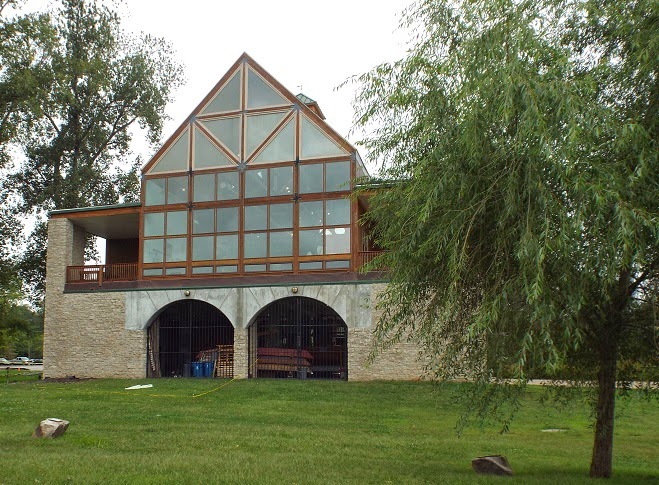
Made long stop at Lewis and Clark Interpretive Center near Nebraska City, NE.   Fairly large building (but not a lot of parking.)    Was built about 10 years ago on the west bank of the Missouri.   In the early 1800s, the open prairie began near what is today Nebraska City.

Excellent statue at the road entry to the Center.

Lewis and Clark Interpretive Center, Nebraska City, NE.


Large 6 foot model of the keelboat inside the museum.

The Interpretive Center is very focused on the natural history (plants and animals) located in this section of the Missouri River.    Lots of great info about the fish of the region!   Also displays about prairie dogs, plants, etc.

There's a reproduction of the famous keelboat right in front of the museum.   A reproduction of the "White Pirogue" is inside the front of the museum.   The pirogues were larger than I had imagined from the books and journals.

Keelboat with reenactor.

Linda at mast of keelboat.  Note the hinge on the mast and the lockers along the gunnels.

Stan at the mast.

We were lucky to arrive on one of the rare days when a number of local reenactors were at the Interpretive Center!   
 

Demonstration of "knapping":  making arrowheads, knives, and spearpoints from flint using a deer antler.

Entrance to Earth Lodge.    A typical building used by a number of tribes along the Missouri.


Interior of Earth Lodge.

The Missouri River at Nebraska City.

   Linda adds:  I am reading a historical novel by Anna Lee Waldo called "Sacajawea".  It was highly acclaimed by the New York Times when it was published in the late  '70's.  It is quite an enjoyable read despite being a rather lengthy book.  There are interesting notes at the back for each chapter.

Saturday, September 13, 2014

Day 4

Saturday, Sept 13.

Internet at last campsite was down yesterday so could not update this blog site until today.

Traveling day.   From St. Louis almost to Kansas City.  Took back roads to get to Hermann, MO, a nice town that focusses on its German heritage.   Several wineries.    Very well-kept farms.   Beautiful country.      Vaguely similar to the Rhine valley in old Germany.

Saw many Lewis and Clark road signs and crossed the Missouri several times. 

On May 24, 1804, Captain Clark wrote in his journal: 

Rain last night.   The river fell several inches.  Set out early, passed several islands.  Passed Wood River on the larboard side at about two miles.  Passed creek on the starboard call La Queur at five miles.  Passed a creek at eight miles, opposite an island on the larboard side.  Camped at the mouth of a creek called La Charette above a small French village of seven houses and as many families, settled at this place to be convenient to hunt and trade with the Indians.

Lewis fell off a cliff along the Missouri somewhere along here.  Landed on a ledge about 20 feet down.   Perhaps it was like the cliff in this photos.


We're set up for the night in a KOA.   It seems to be full!  


Stella on guard.
 

Day 3

September 12, 2014.   Still staying in Villa Ridge, MO, SW of St. Louis.


We dedicated this day to seeing several locations in the St. Louis area that are historically important to the Corps of Discovery. We first went to the Arch on the Mississippi waterfront in St. Louis. A very impressive structure we'd visited about 20 years ago when we lived in Kansas. It was a cold, gray, windy day. Stella stayed to guard the campsite.


At the Arch we visited the underground museum, the 1890s style Emporium, and gift shop. One of the more interesting exhibits in the museum is the large number of presentation medals prepared by the British and US governments to give to Native American Indian chiefs.
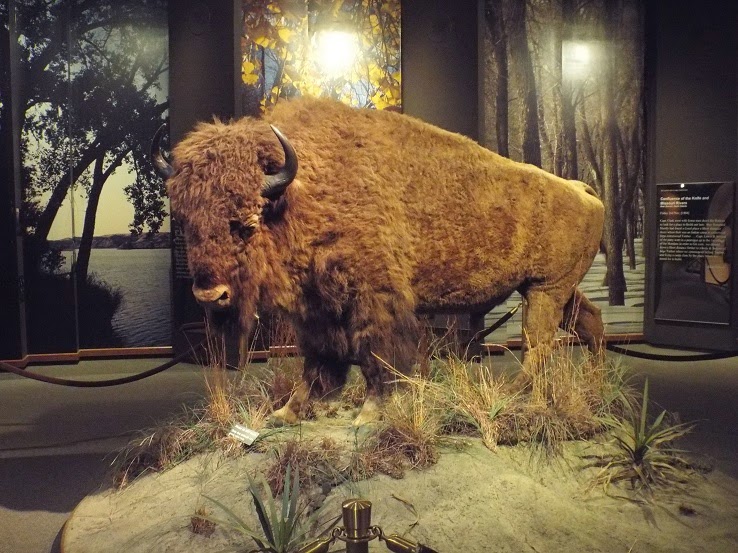
Stuffed buffalo in the Arch Museum

It was fascinating to look at the Mississippi and think of the Expedition working its way upstream in all that current to get to the Missouri. This is also the location where Robert E. Lee made an early reputation for himself by diverting the Mississippi so that the St. Louis waterfront would not be buried in silt.
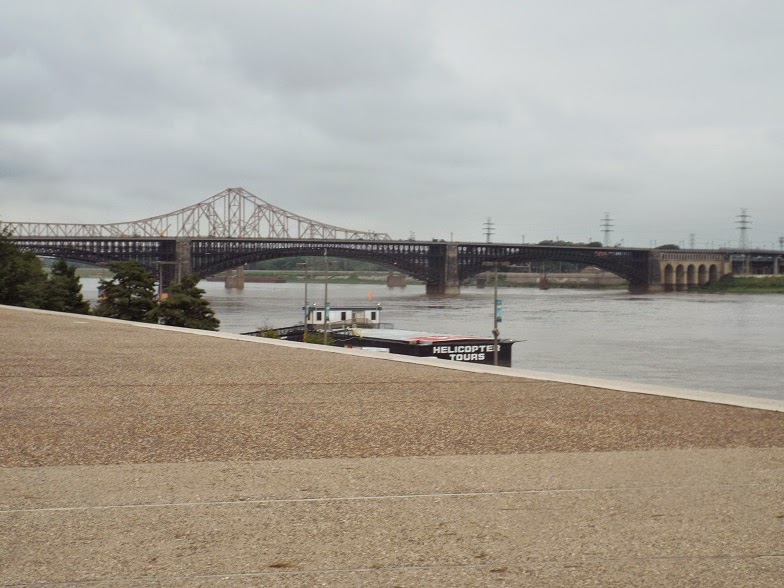
Historic Eads bridge over the Mississippi just north of the Arch.

We then drove about 20 miles to St. Charles, once a small town on the Missouri. Clark brought the keelboat and 2 pirogues to St. Charles to wait for Lewis in mid-May of 1804. The cargo in the boats had to be reloaded at St. Charles so the boats could better deal with snags and mudflats. At that time, the little town had about 100 houses and 450 people, mostly French.
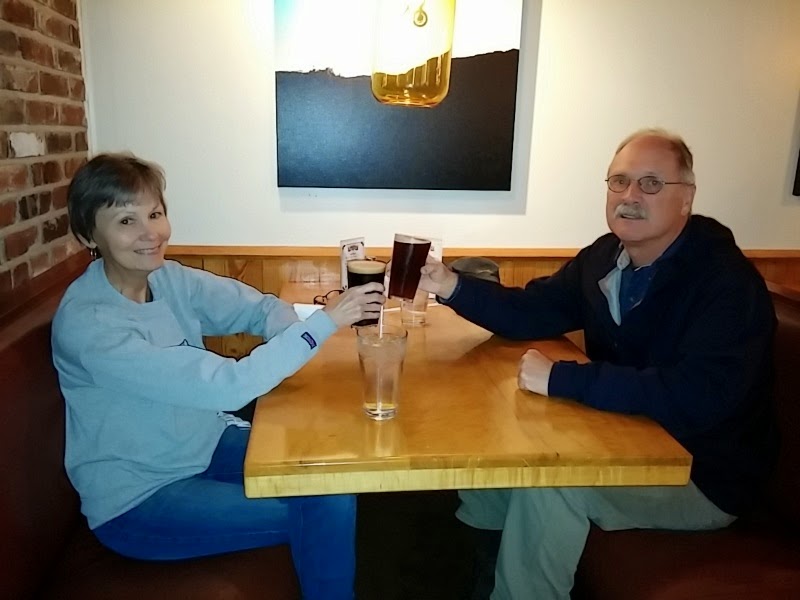
Raising a glass to Lewis, Clark, and the Corps of Discovery at Trailhead Brewery.


Lewis and Clark museum with boathouse.
Today, St. Charles is home to a very nice Lewis and Clark museum and many antique stores and restaurants that cater to tourists and better-heeled locals. We had lunch at the Trailhead Brewery which has a good restaurant. The Lewis and Clark Museum is run by a local group and is excellent. There are reproductions of the keelboat and pirogues in the boathouse below the museum but they are behind bars and difficult to see. The museum has a really excellent series of dioramas that uses the rivers and mountains to depict key actions taken by the Corps as they traveled northwest across the continent.
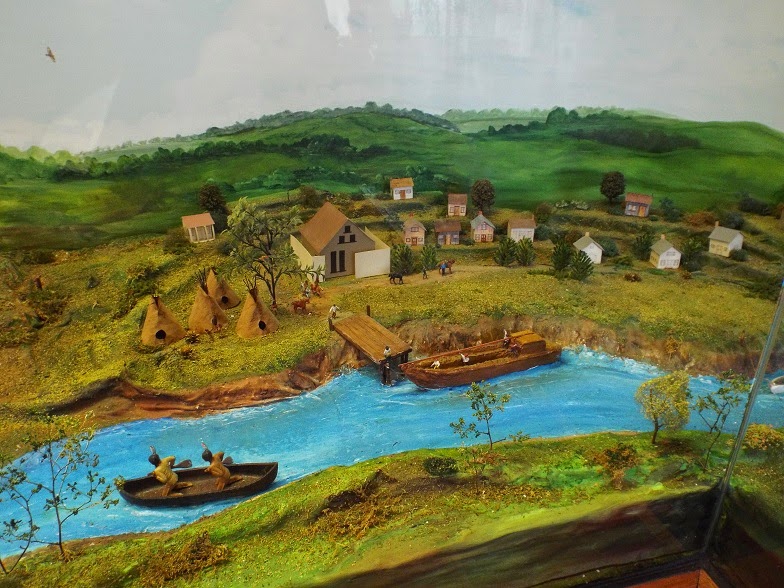
Diorama depiction of St. Charles as the Expedition reloads the keelboat.

More of the long diorama.   Models in the foreground depict Fort Mandan in the winter of 1804-5.   Excellent!
There's a very large set of statues of Captain Lewis, Captain Clark, and the huge dog Seaman in Frontier Park in St. Charles, MO.
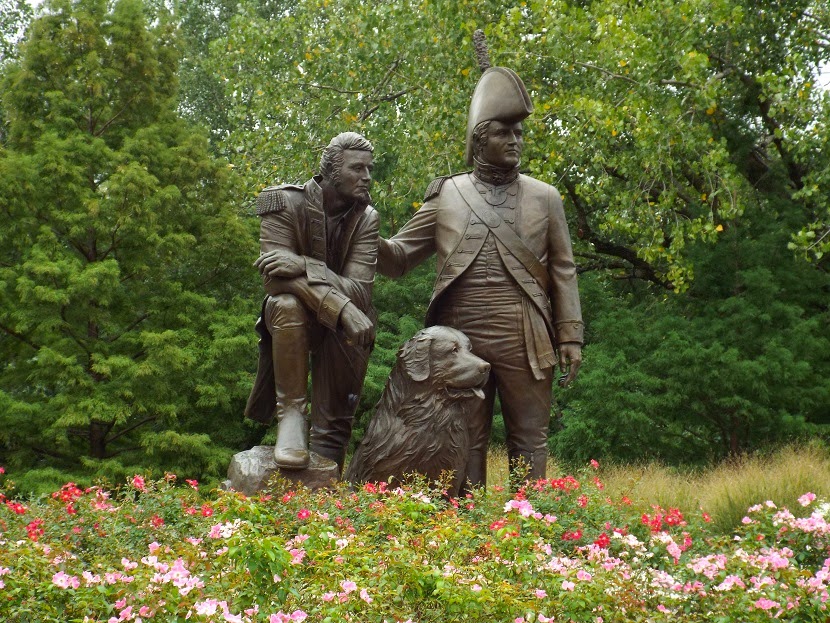
Epaulets on right shoulder indicate the rank of Captain in the US Army of 1804.   They often wore full dress uniform in 1804 while having meetings with Native American Indians.


It was great to again be on the shores of the Missouri. We lived within 2 miles of the old river for several years in Kansas and have seen it flood well out of its banks in 1993.

The Missouri at St. Charles.   Flotsam is very common in the river, especially at high water times.

Stephen Ambrose writes:

“As the keelboat turned her bow into the stream, Lewis and his party cut themselves off from civilization. There would be no more incoming letters, no orders, no commissions, no fresh supplies, no reinforcements, nothing reaching them, until they returned.”

We continue our journey West tomorrow.

Linda Adds:

  It is good to have packed layers as the temperatures plummeted today and our light jackets felt good...very cool for early September and we felt fortunate to have checked the weather while others shivered in summer attire. Despite the weather, really enjoyed the day.

Hit a snag with the internet. Can't complain when you remember how hard it was to send correspondence back to friends, family and associates for Lewis and Clark. It is hard to imagine what people thought had happened to these brave explorers when so little was heard from them. What would they think of all this technology?

Thursday, September 11, 2014

DAY 2


Barges tied to the Illinois shore of the Ohio River.   Mississippi River in distance.
 

Crossed the Ohio and Mississippi Rivers today.   Did it at the only place where the bridges are less than a mile apart....on US 60 at the very southern tip of Illinois.     Nice old narrow steel bridges.   We were in Illinois for about 5 minutes!


Old steel bridge over the Ohio.

 
Approaching the narrow bridge over the Mississippi.   Fun with a travel trailer!


Lewis and Clark brought their big keelboat down the Ohio and then turned north, upstream, in the Mississippi.    They had many of their soldiers with them and would recruit more up in St. Louis.   Clark spent the winter with the soldiers at a rural camp outside the town, while Lewis purchased more supplies, visited people, and attended balls.    St. Louis was already a trading town.

Confluence of the Mississippi and Ohio Rivers as viewed from the Mississippi bridge.


Like William Clark, we're camped outside of St. Louis.    Stella is very happy to be stationary.   We did slightly over 200 miles today.     Interesting changes in terrain.   Western Kentucky near Wycliffe is fairly hilly.   Missouri, on the other side of the Mississippi is very flat for a number of miles as you head west and north.    Halfway to St. Louis, you again encounter hilly, rolling terrain.   Lots of Germans in eastern Missouri.   Must be good farmland.

Weather has been gray and rainy.  Temperature is about 60 degrees at 5pm Central Time.

Linda adds:  As we truly begin our trip west, we, like Lewis and Clark, add to our supplies.  Despite servicing our truck before leaving, we found windshield wipers were improperly installed and of poor quality.  Can't help but think how much our frontier explorers would have liked Walmart!  Like Seaman, Lewis' dog, Stella is enjoying all the new scents.

Wednesday, September 10, 2014

DAY 1

Traveled approximately 400 miles today.    Will reduce this distance in future but we wanted to get west of the Mississippi as soon as was reasonable.

We're in a campground at the north end of Lake Barkley in far western Kentucky.   Nice small place with friendly staff.    Only unusual site today was seeing tobacco harvested not far north of the TN/KY border.  

As usual, the most stressful part of any day pulling the trailer is finding fuel at gas stations that are large enough to accommodate the length of the truck and trailer.   Had to drive out of a Pilot station because we just could not fit.

Stella, the wonder dog, has been unusually quiet.   Usually she whines in the back seat of the truck during the first day of a trip.   Today, she slept and just seemed happy to be along for the trip.

Tomorrow is September 11.   We hope it brings no tragedies.   Mr. Obama addresses the nation tonight.   We'll listen to see if there are any warnings or hints.

Added by Linda:  It is nostalgic to be in Eddyville....not far from my home town of Murray and even closer to my first post-graduate job in Princeton.  It is still a very small town.  Eddyville is a relatively new town, created on this spot after the original settlement was forced underwater with the dam established on the Tennessee River.  Amidst the anger of local citizens, a politician by the name of Lyons offered all residents and businessmen free land, which he owned, to replace lost acres.  Very diplomatic. 
Our "Fort Clatsop or Bust" slogan is on the back of the trailer.   Linda has made a little Sacagawea who will be like a Flat Stanley for the trip.
 

Tuesday, September 9, 2014

Final Prep.


OK, truck and trailer are packed.  Stella has a fresh bath and comb out.

Waning gibbous moon.   Weather looks to be hot and humid tomorrow.

We leave in the morning.   Should be in St. Louis in several days. 


Friday, September 5, 2014

Books

There are many books about Lewis & Clark, the Corps of Discovery, and how to follow their route to the Pacific.    Here are several that we've read:

Undaunted Courage by Stephen Ambrose.   This is the best known book about the expedition.   It was published in 1996 and helped create a large amount of interest in the expedition just a few years before the Bicentennial of the event.   Well-written by a capable popular historian and professor.  We recommend it highly.    

On the Trail of Lewis and Clark: Yesterday and Today by Bill Yenne.  Large format, "coffee table" book with many photos, paintings, maps, etc.    Not often reviewed, but an excellent introductory book about the Corps of Discovery.   An excellent book for ages 10 to adult.   Read this one first, if you can find it.

Lewis and Clark: Partners in Discovery.   A biography by John Bakeless.   Has more personal detail about Lewis and Clark than any book we've found.   Lots of interesting info.  Excellent info about the Northwest Indian war and roles these young men played in it.   Was written in the 1950s and would not be considered "Politically Correct" today.  Highly recommended for those interested in the historical background of the expedition and its participants.

Lewis and Clark Road Trips: Exploring the Trail across America by Kira Gale.   Large format, many maps, many photos.    Lots of research done to create this book...a manual of how to travel the route today.    Will add more to this review after trip completion.

Traveling the Lewis and Clark Trail, 4th Edition by Julie Fanselow.    Standard format softcover.    Similar to the book above but a more conversational style, with many fewer maps and illustrations.   Excellent writing with interesting detail.